Upheaval buckling analysis for buried pipelines
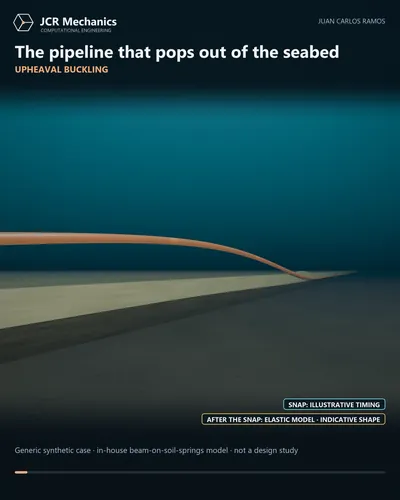
Heat and pressure make a buried pipeline push against its restraint, and the axial force can lift it out of the trench at any vertical imperfection. The analysis finds where that can happen and how much cover or rock is needed to prevent it.
When you need it
- An as-laid or as-trenched survey has found vertical imperfections higher than the design assumed.
- Operating temperature or pressure is being raised on an existing buried line.
- The rock cover or backfill design must be set feature by feature along the route.
- A new crossing, tie-in or reroute changes the profile of a buried section.
What the analysis covers
- Restrained axial force from temperature and pressure, including end effects and feed-in from adjacent sections.
- The as-laid imperfection profile taken from the out-of-straightness survey.
- Non-linear uplift resistance of the backfill or rock cover, with its mobilisation displacement.
- Onset temperature for each feature and the post-buckling response if the cover is exceeded.
- Mitigation length and position: cover height, rock volume or download design along the route.
What we need from you
- Pipe, coating and content data: diameter, wall thickness, material and densities.
- Operating envelope: design and operating pressure and temperature, with the temperature profile along the line.
- Out-of-straightness survey or route profile, as laid or as trenched.
- Soil and backfill data: type, strength, density and the planned cover or rock grading.
- Project acceptance criteria and safety class, if already defined.
What you receive
- A report with assumptions, method, verification against a hand calculation, and margins against the agreed criteria.
- Required cover or rock height at each feature, ready to turn into an intervention plan.
- The scripted model files and a results review call.
- Where it helps, a short animation that explains the result to non-specialists.
Codes and standards
- DNV-RP-F110
- DNV-ST-F101
- DNV-RP-F114
The assessment is framed against the edition your project specifies.
Related cases
Generic, synthetic studies from the portfolio that show this kind of analysis at work.
Questions clients ask
Can a pipeline buckle upward below its design temperature?
Yes. The buckling threshold is the axial compression the cover can hold at each imperfection, and it falls as the imperfection grows or the cover thins. If the as-built profile or cover differs from the design basis, a feature can buckle at a lower temperature than expected.
How is the cover height or rock volume set from the survey?
Each imperfection in the survey is assessed for the uplift resistance it needs at the design conditions. That resistance is converted to cover height with the uplift model of the backfill or rock, applying the safety factors of the design approach in DNV-RP-F110. The volume follows from the required height and length at each feature.
What is the difference between upheaval and lateral buckling?
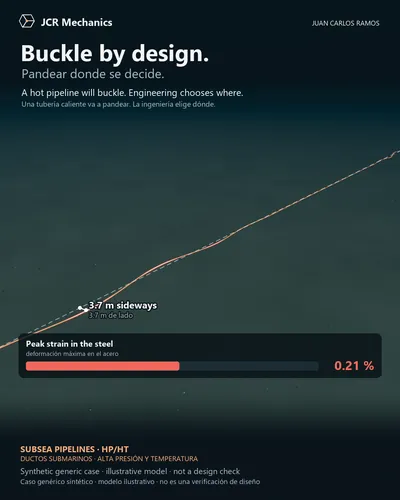
Both are global buckling driven by restrained axial compression. A buried pipe buckles upward because the surrounding soil resists sideways movement more than the cover resists uplift. An exposed pipe on the seabed usually buckles sideways, because lateral friction is its weakest restraint.
Contact
Have a case like this?
Send the question and the data you can share. You will get back a proposed scope, method and timeline.
Confidential by default: project data is never used in public material.