Lateral buckling analysis and pipeline walking
An exposed HP/HT flowline relieves its thermal expansion by buckling sideways, and a short line can also creep along the seabed with every cycle. The analysis decides whether buckles can be left to form, must be planned, or must be prevented, and whether walking needs an anchor.
When you need it
- A new HP/HT flowline or tieback is being designed to lie exposed on the seabed.
- Survey shows buckles forming in places the design did not plan for.
- Riser, spool or jumper loads are rising because the line is walking towards one end.
- Operating temperature, pressure or the number of start-up cycles is changing.
What the analysis covers
- Effective axial force from pressure and temperature, and the virtual anchor and feed-in length.
- Axial and lateral pipe-soil interaction as ranges, with breakout and residual resistance.
- Buckle initiation and spacing, with sleepers, distributed buoyancy or route curves as initiators.
- Post-buckling strain, bending moment and fatigue at each buckle under cyclic operation.
- Pipeline walking from seabed slope, end tension and transient temperature, and the anchoring it needs.
What we need from you
- Pipe, coating and content data, including thermal insulation if present.
- Operating envelope and the temperature and pressure profiles for start-up, steady state and shutdown.
- Route, bathymetry and as-laid survey, with lay tension if known.
- Geotechnical data for the pipe-soil model: soil type, shear strength and expected embedment.
- End connection details: risers, spools, PLETs and the load limits at each.
What you receive
- A report with assumptions, method, verification against an analytical solution, and margins against the agreed criteria.
- Buckle locations and initiator layout, walking rate and anchor loads if needed.
- The scripted model files and a results review call.
- Where it helps, a short animation of buckle formation and walking for non-specialists.
Codes and standards
- DNV-RP-F110
- DNV-ST-F101
- DNV-RP-F114
The assessment is framed against the edition your project specifies.
Related cases
Generic, synthetic studies from the portfolio that show this kind of analysis at work.
Questions clients ask
What drives pipeline walking?
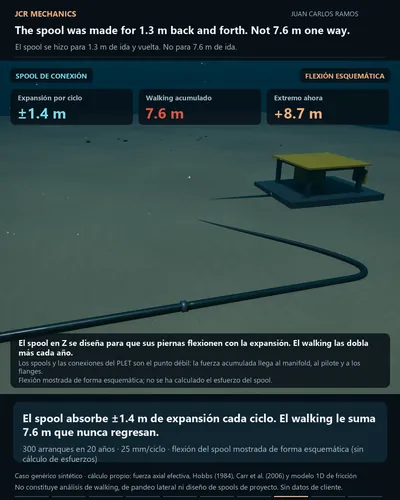
Walking is axial displacement that accumulates over start-up and shutdown cycles in a line too short to become fully restrained. It needs an asymmetry: a seabed slope, a tension at one end from a riser, or a temperature transient along the line at start-up. Its rate depends on axial soil friction and the number of cycles.
Can lateral buckles be planned instead of prevented?
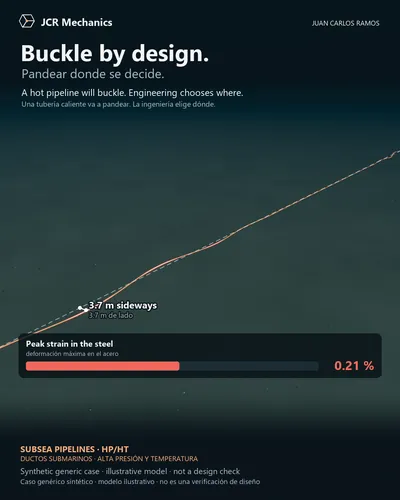
Yes, that is buckle-by-design. Initiators such as sleepers, distributed buoyancy or planned route curves trigger buckles at chosen spacing, so each one takes a limited share of the expansion. The design then checks strain, fatigue and the probability that each buckle forms where intended.
Why is pipe-soil friction given as a range rather than one value?
Soil resistance depends on embedment, drainage and loading rate, and none of these is known precisely before installation. DNV-RP-F114 describes how to estimate it, and the design carries lower, best and upper estimates. Each bound governs a different check, so using a single value can hide the critical case.
Contact
Have a case like this?
Send the question and the data you can share. You will get back a proposed scope, method and timeline.
Confidential by default: project data is never used in public material.