Surge and water hammer analysis
When a pump trips or a valve closes quickly, the liquid column stops and sends a pressure wave along the line. The analysis finds the peak pressures, the vacuum and the pipe forces, and sets the closure times, devices or support changes that keep them within limits.
When you need it
- A new pumping system, loading line or fire water network is being designed.
- Valve closure times, pump control or the emergency shutdown philosophy are changing.
- Supports have moved or failed after a pump trip, or a line bangs when a valve closes.
- Throughput, fluid or line length changes on an existing system.
What the analysis covers
- Hydraulic transient analysis by the method of characteristics, with wave speed from pipe and fluid properties.
- Pump trip and start, valve closure and opening, and check valve behaviour.
- Maximum and minimum pressure envelopes, including column separation and vapour cavity collapse.
- Unbalanced transient forces on each straight leg, passed to the piping stress model.
- Mitigation: closure time, surge vessels, relief devices, bypasses or flywheel inertia.
What we need from you
- Line geometry: lengths, elevations, diameters and wall thicknesses.
- Fluid properties: density, bulk modulus and vapour pressure over the operating range.
- Pump curves and inertia, and the control and trip logic.
- Valve types, characteristics and closure times, including check valves.
- Operating scenarios and the client's pressure limits.
What you receive
- A report with assumptions, method, verification against the Joukowsky estimate, and margins against the agreed limits.
- Pressure envelopes along the line and force-time histories for the stress analysis.
- The scripted model files and a results review call.
- Where it helps, a short animation of the pressure wave for non-specialists.
Related cases
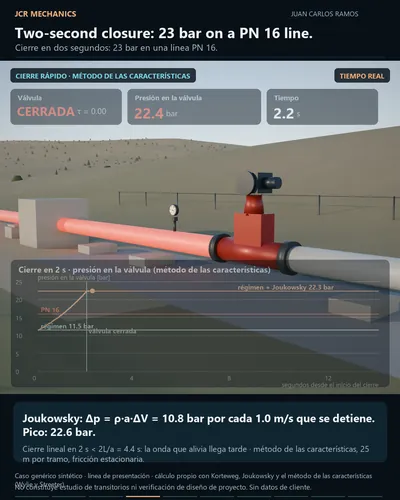
Generic, synthetic studies from the portfolio that show this kind of analysis at work.
Questions clients ask
Which events must be modelled?
The events that change flow quickly: pump trip and start, valve closure and opening, emergency shutdown and check valve slam. Which ones matter depends on the system and its operating philosophy, and the list is agreed before any run. The fastest credible closure and a trip of all pumps at once are common starting cases.
What pressure limit is the surge checked against?
The limits that the applicable piping code sets for occasional pressure variations, together with the client's specification. These limits allow a short exceedance above design pressure under defined conditions, which differ between codes. The analysis reports both maximum and minimum pressure so overpressure and vacuum can be judged.
Does the analysis give loads on the supports?
Yes. A pressure wave moving through the line creates unbalanced forces on each straight leg between elbows, and those forces change in time. They are applied to the piping stress model to check supports, anchors and nozzles in the occasional load case.
Contact
Have a case like this?
Send the question and the data you can share. You will get back a proposed scope, method and timeline.
Confidential by default: project data is never used in public material.