Piping vibration assessment: FIV and AIV
Turbulent flow, pulsation and the high-frequency noise from pressure-reducing devices can make piping vibrate until a weld cracks by fatigue. The assessment screens the system, finds the lines and connections at risk, and sets the changes or measurements that bring the risk down.
When you need it
- A new plant or a debottlenecking raises flow rates, pressure drops or relief loads.
- Operators report visible or audible vibration, or a small-bore connection has cracked.
- Relief, blowdown or control valves pass gas at a high pressure drop into large thin-walled headers.
- A metering, compression or filtration skid is being designed or modified.
What the analysis covers
- Likelihood of failure screening of each line with the Energy Institute guidelines for the avoidance of vibration-induced fatigue failure in process pipework.
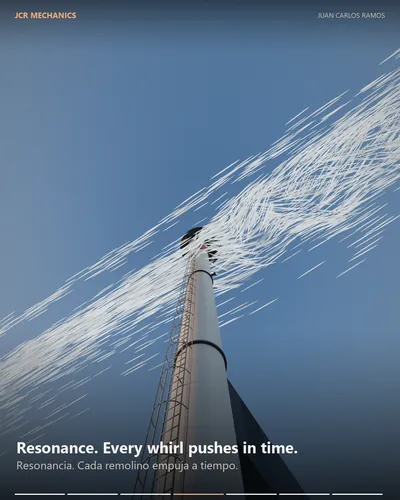
- Flow-induced vibration from turbulence, flow-induced pulsation and slug flow.
- Acoustic-induced vibration downstream of relief, blowdown and control valves and restriction orifices.
- Small-bore connections: natural frequency, bracing and weld detail.
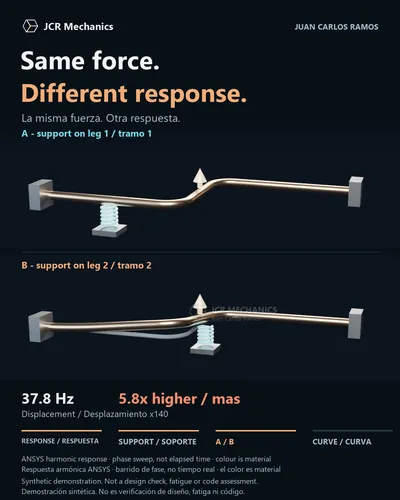
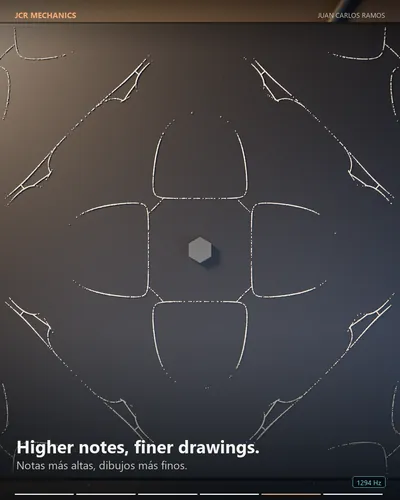
- Mechanical natural frequencies and forced response by finite elements where screening is not enough.
What we need from you
- Process data per line: flow rates, pressures, temperatures, densities and phase.
- Isometrics or a 3D model, with pipe classes and support locations.
- Relief, blowdown and control valve data: set pressures, capacities and pressure drops.
- Small-bore connection details: vents, drains and instrument tappings.
- Vibration measurements and inspection findings, if the plant is in service.
What you receive
- A report with assumptions, method, verification of the screening inputs, and the ranked list of lines and connections at risk.
- Specific mitigation: support changes, bracing, wall thickness or fitting changes, and lines to measure.
- The scripted model files for any detailed analysis and a results review call.
- Where it helps, a short animation of the vibration mode for non-specialists.
Codes and standards
- Energy Institute guidelines for the avoidance of vibration-induced fatigue failure in process pipework
- ASME B31.3
The assessment is framed against the edition your project specifies.
Related cases
Generic, synthetic studies from the portfolio that show this kind of analysis at work.
Questions clients ask
Which lines are prone to acoustic-induced vibration?
Lines downstream of a device that drops gas pressure at high flow: relief and blowdown valves, control valves and restriction orifices. The acoustic power depends on mass flow, pressure ratio and temperature. The risk is highest in large-diameter, thin-walled pipe with welded branches or supports.
What does a likelihood of failure score mean?
It is a ranking from the Energy Institute guidelines, built from flow, fluid properties, geometry and supports. A high score does not mean the line will fail; it means it needs closer review, measurement or redesign. The score is only as good as the process data, so it is revisited as the design develops.
Why do small-bore connections fail so often?
A vent, drain or instrument tapping is a concentrated mass on a short cantilever, so its natural frequency can fall in the range the main line excites. The stress concentrates at the weld to the main pipe. Bracing back to the main line, so the connection moves with it, is a common remedy.
Contact
Have a case like this?
Send the question and the data you can share. You will get back a proposed scope, method and timeline.
Confidential by default: project data is never used in public material.