On-bottom stability analysis for subsea pipelines
Waves and current push and lift a pipeline on the seabed, and the soil resists through friction and the embedment the pipe builds as it moves. The analysis sets the concrete weight coating, burial or rock needed so the line stays within an acceptable displacement over its life.
When you need it
- A new subsea pipeline needs its concrete weight coating or wall thickness set for stability.
- The simplified method asks for more coating, rock or trenching than the project can afford.
- The route crosses a shore approach or shallow water where wave action is strongest.
- A survey shows the line has moved, or the metocean basis has been revised.
What the analysis covers
- Hydrodynamic drag, inertia and lift from combined waves and current at the seabed.
- Pipe-soil lateral resistance, including passive resistance that builds with embedment.
- Stability for each phase: empty, flooded, hydrotest and operation.
- Dynamic lateral stability in the time domain, with the accumulated displacement over a storm.
- Mitigation options: concrete coating, trenching, burial, rock berms or mattresses.
What we need from you
- Pipe, coating and content data for each phase, including concrete density and thickness options.
- Metocean data: wave height and period, current profile and directions, with return periods.
- Route and bathymetry, from shore approach to the deepest section.
- Geotechnical data: soil type, shear strength or friction angle, and density.
- Allowable displacement and any limits set by nearby assets or crossings.
What you receive
- A report with assumptions, method, verification against the simplified method, and margins against the agreed criteria.
- Required weight coating or mitigation along the route, by water depth and phase.
- The scripted model files and a results review call.
- Where it helps, a short animation of the line under a design storm for non-specialists.
Codes and standards
- DNV-RP-F109
- DNV-RP-F114
- DNV-ST-F101
The assessment is framed against the edition your project specifies.
Related cases
Generic, synthetic studies from the portfolio that show this kind of analysis at work.
Questions clients ask
When is a dynamic analysis worth it over the simplified method?
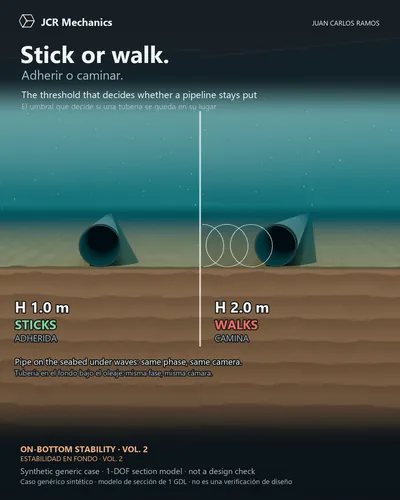
The simplified methods in DNV-RP-F109 either allow no movement or use generalised curves, and both tend to be conservative. A dynamic analysis models the time-varying loads and the soil resistance that builds as the pipe moves. It pays off when the simplified result drives a large coating, rock or trenching cost.
How is the design sea state chosen?
It depends on the phase and its duration. For the permanent condition, where joint wave and current statistics are not available, DNV-RP-F109 combines a long return period for one with a shorter one for the other. Temporary phases, such as an empty line before flooding, can use shorter return periods tied to how long they last.
What makes a shore approach different?
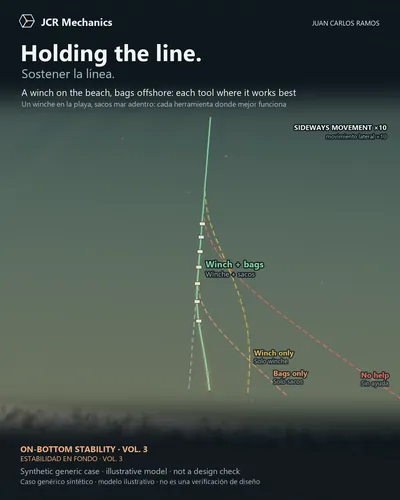
Near the shore waves shoal and break, flow velocities at the seabed rise, and the seabed itself can move. Stability there often relies on burial or trenching rather than weight alone. The analysis checks the depths where waves are most severe, during installation and as the beach profile changes.
Contact
Have a case like this?
Send the question and the data you can share. You will get back a proposed scope, method and timeline.
Confidential by default: project data is never used in public material.